Get Our Latest Insights & News to Stay Updated
Stay ahead in the tech world with Zectagon Technologies latest insights and news! Discover industry updates, expert tips, and trends that inspire and empower you. As the leading software service provider in India, we deliver valuable content to help your business flourish in the digital age.
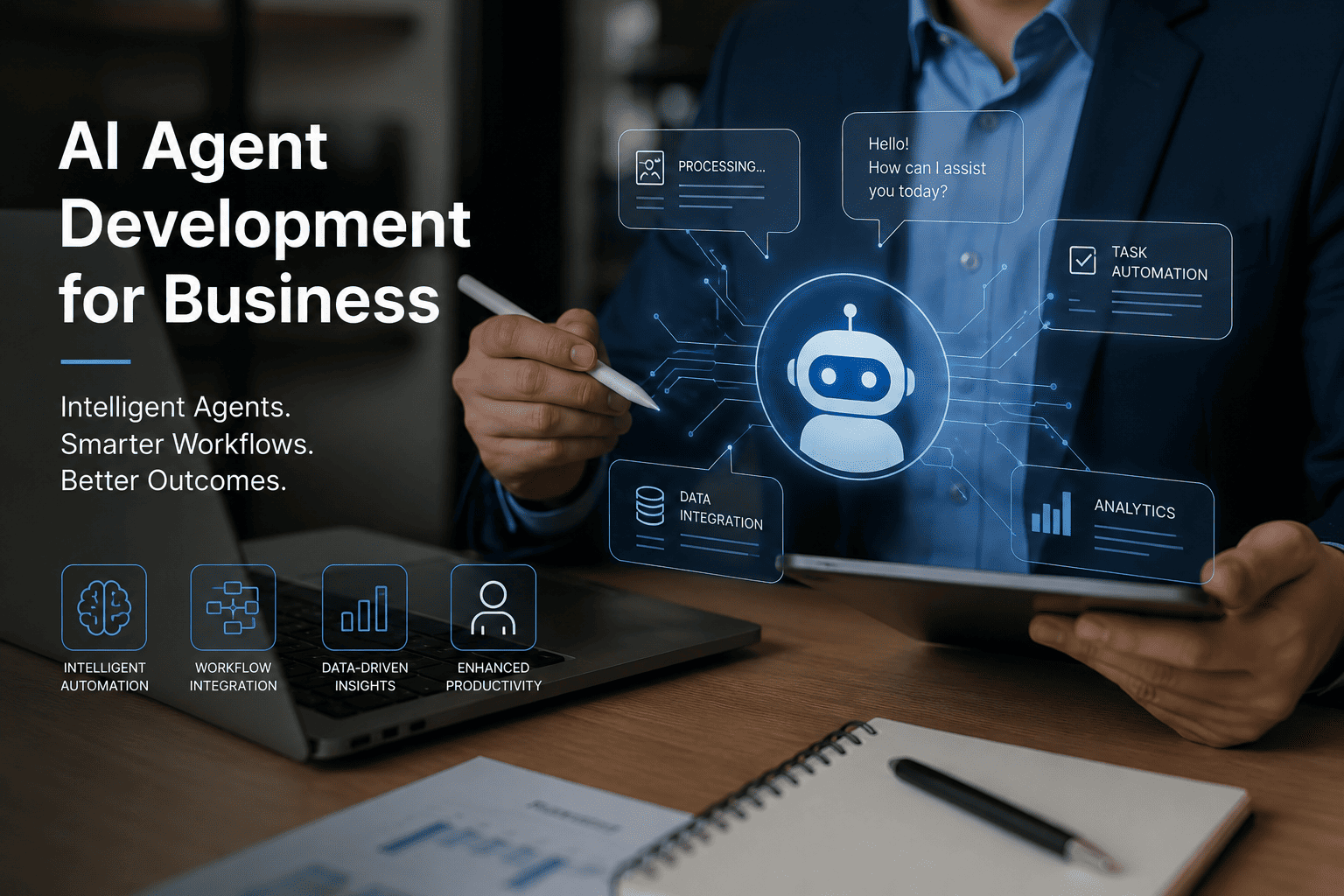
AI Agent Development for Business: The 2026 Playbook for Enterprise Leaders
For two years, enterprise AI was defined by chatbots that answered questions and copilots that drafted emails. Useful? Yes. Transformative? Not quite.
In 2026, the conversation has changed entirely. Businesses are no longer asking "Can AI help my team?" they're asking "Can AI run my workflows?" This is the era of Agentic AIAutonomous systems that interpret objectives, plan multi-step actions, and execute across your tech stack without waiting for human approval at every turn.
Unlike earlier AI tools that required constant prompting, modern AI agents maintain contextual memory, coordinate across systems, and adapt to changing conditions in real time. The result? Faster decision cycles, reduced operational overhead, and measurable ROI often within the first year of deployment.
The Numbers Don't Lie: What's Driving Enterprise Adoption
| Metric | 2026 Reality |
|---|---|
| Average enterprise ROI | 171% (192% for US enterprises) |
| Companies achieving ROI in Year 1 | 74% |
| Enterprise apps with task-specific AI agents | 40% (up from <5% in 2025) |
| Payback period (buy/configure) | 8 to 18 months |
| Payback period (build from scratch) | 18 to 36 months |
Real-world deployments confirm the trend. Klarna's AI agent handles the workload of 853 full-time employees and has saved $60 million. JPMorgan runs 450+ production agents across legal, compliance, and trading. AMD reduced HR resolution times by 80% in just 90 days.
Gartner's projection that 40% of enterprise applications will include task-specific AI agents by end of 2026, up from under 5% in 2025, signals that this isn't a niche trend. It's becoming the default architecture for modern business operations.
The 6 High-ROI Use Cases Delivering Results Right Now
Not every workflow is a good candidate for agentic AI. The highest-ROI deployments share a clear profile: high volume, semi-structured inputs, measurable outputs, and repetitive judgment calls with human fallback available.
- Customer Service Automation (Fastest ROI: 3 to 6 months) Agents classify queries, retrieve customer context, generate responses, and escalate intelligently. Klarna's results, 24/7 multilingual support with customer satisfaction matching human agents, set the benchmark. Typical ROI: 40 to 60% reduction in cost per contact.
- Software Engineering Automation (ROI: 6 to 12 months) Autonomous issue resolution, PR review, test generation, and security scanning. Teams report 45% faster code review cycles and 60% reduction in priority-1 bug resolution time.
- Financial Compliance & Legal (ROI: 6 to 18 months) KYC/AML document review, contract red-lining, and regulatory reporting. McKinsey reports 200% to 2,000% productivity gains in banking KYC workflows. The Evaluator-Optimizer pattern raises accuracy from ~74% to 97%+.
- HR Operations (ROI: 3 to 9 months) Policy Q&A, onboarding workflows, leave/benefits queries. AMD's deployment achieved 80% faster HR inquiry resolution and 70% employee satisfaction within 90 days.
- Supply Chain & Procurement (ROI: 9 to 18 months) Demand forecasting, vendor communication, exception handling, and PO automation. Amazon's robotics and supply chain agents delivered 25% faster delivery and 25% overall efficiency gains.
- Marketing & Content Operations (ROI: 3 to 6 months) 46% faster content creation, 32% faster approval cycles, and 3 to 5x more content variants for A/B testing without additional headcount.
The Framework Landscape: What to Build With in 2026
Choosing the right AI agent development platform is no longer about chasing the newest demo it's about production reliability, governance, and integration with your existing stack.
For Engineering-Heavy Teams:
- LangGraph Best for structured, stateful orchestration with deterministic control points. Ideal for regulated workflows like underwriting and compliance.
- CrewAI Best for role-based "agent teams" and fast prototyping of multi-step pipelines.
- Microsoft AutoGen Best for conversational multi-agent collaboration and iterative critique loops (ideal for coding agents).
- Microsoft Semantic Kernel Purpose-built for .NET/Java enterprises with strong governance, Azure AD integration, and audit controls.
- OpenAI Agents SDK Best for teams standardizing on OpenAI with minimal infrastructure burden and built-in safety controls.
- Google Agent Development Kit (ADK) Optimized for Gemini-based multimodal agents with native Google Cloud, BigQuery, and Workspace integration.
- n8n, Dify, Flowise Visual builders that blend SaaS automation with AI steps, enabling ops teams to iterate without engineering bottlenecks.
Architecture Patterns That Win in Production
- The "Supervisor + Specialists" Pattern Instead of one "do everything" agent, use a supervisor to route tasks and specialist agents for narrow jobs (extraction, classification, drafting). Narrow agents are easier to evaluate, debug, and improve.
- Human-in-the-Loop Checkpoints Autonomy should be earned, not assumed. Auto-run read actions. Require human review for write actions, external communications, and high-risk decisions until you've proven reliability with evaluations and logs.
- Guardrails and Output Schemas Most production failures come from malformed outputs and hallucinated tool arguments not "bad reasoning." Use structured JSON outputs, validators, and retry logic that forces correction rather than improvisation.
- Observability is Non-Negotiable If you can't answer these questions, you're not ready to scale: What did the agent do, step by step? Which tools did it call, with what arguments? What did it cost per run? How often does it fail, and where? How does it perform on a fixed evaluation set compared to last week?
Governance-First Design: The 2026 Imperative
As autonomy increases, so does the need for control. In 2026, governance isn't an afterthought it's built into system design from day one.
- Permission boundaries: Agents act only within approved scopes
- Decision logs: Complete audit trails of every action
- Approval checkpoints: Automatic pauses when actions exceed risk thresholds
- Circuit breakers: Stop runaway tool calls or cost spikes
- Model-agnostic routing: Swap models per task based on cost, speed, or safety needs
How Zectagon Helps in AI Agent Development
At Zectagon, we don't just build AI agents we architect autonomous systems that deliver measurable business outcomes. Our end-to-end AI agent development services are designed for enterprises ready to move from experimentation to production-grade deployment.
1. AI Agent Strategy & Use Case Discovery
We start by identifying the highest-ROI workflows in your organization the ones with high volume, semi-structured inputs, and clear success metrics. Our discovery process maps your operational pain points to agentic AI opportunities, ensuring you invest in the right use cases from day one.
2. Custom Agent Architecture & Framework Selection
Whether you need deterministic orchestration with LangGraph, enterprise governance with Microsoft Semantic Kernel, or rapid prototyping with CrewAI we select and configure the optimal framework stack for your infrastructure, compliance requirements, and failure tolerance.
3. Multi-Agent System Design & Orchestration
We implement the proven "Supervisor + Specialists" Pattern, designing agent teams that collaborate intelligently. Our architectures include contextual memory, tool integration, and inter-agent communication protocols that scale from single workflows to enterprise-wide automation.
4. Governance-First Implementation
Every Zectagon deployment includes built-in governance: permission boundaries, decision logging, approval checkpoints, circuit breakers, and model-agnostic routing. We ensure your agents operate safely, transparently, and within regulatory frameworks from SOX to GDPR to industry-specific compliance.
5. Tool Integration & API Orchestration
Your agents need to work with your existing stack. We integrate with CRMs (Salesforce, HubSpot), ERPs (SAP, Oracle), communication platforms (Slack, Teams), databases, and custom APIs enabling agents to read, write, and act across your entire technology ecosystem.
6. Observability, Monitoring & Continuous Improvement
Production agents require production-grade monitoring. We implement comprehensive observability: step-by-step execution tracing, cost-per-run analytics, failure analysis, and automated evaluation pipelines. This ensures your agents improve over time, not degrade.
7. Deployment, Scaling & Change Management
From shadow mode to limited rollout to full-scale deployment, we manage the entire lifecycle. Our phased approach minimizes risk while building organizational confidence with clear escalation paths, human-in-the-loop checkpoints, and team training programs.
8. Ongoing Optimization & Model Management
AI models evolve. We provide continuous optimization services: model performance benchmarking, cost optimization, prompt engineering refinements, and architecture updates as new frameworks and capabilities emerge. Your agents stay cutting-edge without constant re-engineering.
Ready to Transform Your Business with AI Agents?
Check out our AI Agent Development page to learn more.
The Zectagon Perspective: From Experiment to Operational Asset
At Zectagon, we see three phases in every successful AI agent deployment:
- Week 1: Pick One Workflow & One Metric Tight scope beats five half-working demos. Choose high-volume, semi-structured processes with clear inputs, outputs, and owners.
- Weeks 2 to 3: Add Tools, Memory & Guardrails Start with minimum viable integrations. Define output schemas, validation rules, retry behavior, and fallback procedures.
- Week 4+: Shadow Mode to Limited Rollout to Full Scale Ship with discipline. Run in shadow mode first, then limited rollout with clear escalation paths, then full deployment only after evaluation results stabilize.
Bottom Line
AI agent development for business has crossed the chasm from experimentation to operational necessity. With 74% of enterprises achieving ROI within year one and average returns of 171%, the question is no longer whether to adopt agentic AI it's how fast you can deploy it responsibly.
The winners in 2026 will be businesses that combine autonomous capability with governance-first design, turning AI agents from experimental projects into reliable operational assets that drive competitive advantage.
Python Development in the AI Era: Powering Intelligent, Scalable, and Future Ready Solutions
Python is no longer limited to traditional backend development. It now serves as the backbone for intelligent systems that learn, adapt, and scale, enabling businesses to innovate faster, reduce operational complexity, and maintain a competitive edge. Why Python Dominates Modern Software DevelopmentPython’s dominance in modern software engineering is driven by its simplicity, flexibility, and enterprise grade capabilities. Its clean and readable syntax significantly accelerates development cycles, reduces maintenance overhead, and improves collaboration across engineering teams.
Python’s extensive ecosystem supports:
- Web application development
- High performance APIs
- Data engineering and analytics
- Artificial Intelligence and Machine Learning workloads
- Automation and DevOps pipelines
Its powerful AI and data science ecosystem includes:
- TensorFlow, PyTorch, Keras for deep learning
- Scikit learn for machine learning
- Pandas and NumPy for data manipulation
- spaCy and NLTK for natural language processing
- OpenCV for computer vision
- Predictive analytics and forecasting
- Recommendation engines
- Fraud detection and risk analysis
- Conversational AI and chatbots
- Intelligent process automation
At the same time, security, compliance, data privacy, and ethical AI practices have become essential components of professional Python development in regulated and large scale environments. Zectagon Technologies: Python and AI Engineering ExpertsAt Zectagon Technologies, Python development is a core specialization aligned with an AI first future. Zectagon Technologies delivers secure, scalable, and intelligent Python solutions across industries including SaaS, logistics, fintech, and digital platforms. Zectagon Technologies’s Python and AI Expertise Includes:
- Custom Python application development
- High performance backend systems and APIs
- AI and machine learning solution development
- Intelligent automation platforms
- Data engineering and analytics pipelines
- Cloud native, microservices based architectures
- Faster and predictable delivery
- Flexible team scaling
- Direct technical collaboration
- Strong IP protection and confidentiality
By combining deep Python expertise, advanced AI engineering capabilities, and dedicated development resources, Zectagon Technologies empowers businesses to build intelligent, scalable, and future ready digital solutions. Let’s connect and explore how Python and AI can transform your business.Let’s build something amazing together.Write to us at team@zectagon.com or call us at +91 70627 69786 for any queries.
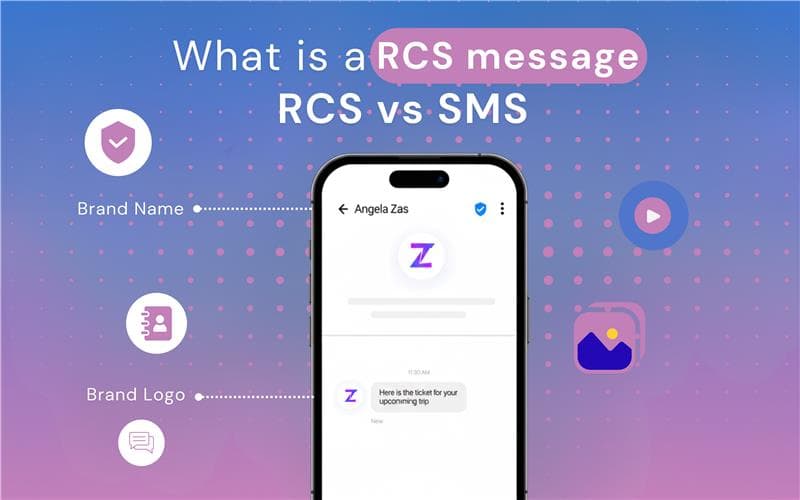
Google RCS Messaging: The Future of Business Communication
From AI powered messaging to transactional automation, RCS delivers a WhatsApp like experience directly inside a user's default messaging app without requiring installation of any third party platform. What is Google RCS Messaging?Google RCS (Rich Communication Services) is the next generation messaging protocol designed to replace standard SMS and MMS. It enables businesses and consumers to exchange:
- Rich media (images, GIFs, videos)
- Buttons & CTAs
- Verified business profiles
- Transactional and promotional messages
- AI enabled conversational flows
- Business gets verified via Google RCS
- Templates and messaging workflows are approved
- User receives rich interactive messages
- AI or automation handles responses
- Analytics track delivery, clicks, and conversions
| Feature | SMS | RCS |
|---|---|---|
| Branding | ❌ | ✔ Verified Sender |
| Buttons & CTA | ❌ | ✔ Interactive |
| File Support | Limited | ✔ HD Media |
| Read Reports | ❌ | ✔ Yes |
| Typing Indicator | ❌ | ✔ Yes |
| AI Integration | ❌ | ✔ Yes |
- OTPs
- Offers
- Reminders
- Booking confirmations
- Lead funnels
| Limitation | Status |
|---|---|
| Apple device support | ❌ (Coming late 2025-26) |
| Needs internet | ✔ |
| Carrier approval required | ✔ |
| More expensive than SMS | ✔ |
| Limited awareness among SMBs | ✔ |
| Category | Approx Cost (India) |
|---|---|
| Promotional messaging | ₹0.17 - ₹0.20 |
| Transactional message | ₹0.17 - ₹0.18 |
| AI conversation session | Based on API usage/session |
| Industry | Use Case |
|---|---|
| BFSI | Loan reminders, KYC, offers |
| Retail | Promotions, flash sale catalogs |
| eCommerce | Order tracking, verification |
| Travel | Boarding passes, itineraries |
| Auto | Brochures, test drive booking |
| Healthcare | Appointment reminders |
| Telecom | Recharge, billing |
| Government | Citizen information, alerts |
Supports integrations like:
- CRM
- Webhooks
- ERP
- WhatsApp and Omni channel automation
- Chatbots & AI NLP systems
- Marketing Platforms
| Capability | Details |
|---|---|
| RCS Brand Registration | Verify business with carriers & Google |
| API Integration | Connect CRM, ERP, Chatbots & automation |
| Template Approval & Compliance | Manage messaging workflow approvals |
| Automation & Chatbots | Smart responses, conversational flows |
| Campaign Management | Broadcast, segmentation & retargeting |
| Analytics & Reporting | Track delivery, CTR, conversions & funnel insights |
| Area | Zectagon Technologies Contribution |
|---|---|
| Lead Generation Automation | Create smart interactive funnels |
| Customer Support Automation | AI + RCS hybrid support model |
| Billing & Notification Flow | Automated reminders, OTP, receipts |
| Rich Communication Marketing | Carousels, catalog, offers, cross-sell |
| Integration with Existing Systems | Salesforce, HubSpot, Zoho, SAP, custom platforms |
- Natural Language Processing
- Generative AI
- Automated reasoning
- Customer journey mapping
This enables:
- Personalized messaging
- Behavior based triggers
- Automated follow ups
- Human handover when needed
As RCS continues to evolve with wider adoption and deeper AI integration, it represents a fundamental upgrade to business communication. For companies looking to stay ahead in customer engagement, adopting RCS now means building for the future of messaging where every interaction is rich, interactive, and intelligent. Want to implement RCS for your business?Let's Build Something Amazing Together!Write us at team@zectagon.com or Make a Call +917062769786 for any query.
React vs CMS for SEO: Which is Better for Your Website?
Let's explore the trade offs, recent innovations in React and how you can make the right decision. Finally, we'll see how Zectagon Technologies Implement React to deliver SEO friendly sites. What CMS Offers for SEOA Content Management System (CMS) traditionally offers many SEO friendly features out of the box:
- Tools/plugins for SEO meta tags, title/description, XML sitemaps, breadcrumbs
- Themes or templates designed for SEO
- Easy content management: writers can upload content without a developer
- Built in blogs, media galleries, directory structures, and user friendly UI for updating content
- Community plugins to support multilingual sites, Open Graph tags, performance caching, security, etc.
- Themes/plugins not always optimized, can cause bloated JS/CSS, which slows load times
- Less control over performance optimizations (SSR, code splitting, lazy loading)
- Sometimes updates/plugins break SEO settings or introduce complexity
- Scaling a heavily trafficked CMS website can become a challenge unless carefully optimized
- React Server Components (RSC): Allow you to render parts of the UI on the server, send minimal HTML and data to the client, reducing client side JS and improving SEO visibility.
- Enhanced SSR & Streaming SSR: Faster initial rendering, better metrics like First Meaningful Paint and Largest Contentful Paint.
- Concurrent Rendering, Automatic Batching, Suspense / Lazy Data Fetching: Reduce blocking operations, faster UI rendering, improved UX.
- Static Site Generation (SSG) & Incremental Static Regeneration (ISR): Pre rendered pages for blogs/product catalogs, regenerating at intervals for SEO + speed.
- Meta Tag & Head Management: Tools like Next.js Head or React Helmet handle titles, descriptions, canonical tags, structured data properly.
- Image Optimization & Core Web Vitals: Responsive images, lazy loading, better mobile speed crucial for rankings.
| Factor | CMS (e.g. WordPress) | React (Modern stack) |
|---|---|---|
| Out-of-box SEO tools | Strong: plugins for sitemaps, SEO settings, structured data available easily | Manual setup, but more control & customization possible |
| Speed / performance | Dependent on theme/plugins; often heavier; caching required | Highly optimizable: SSR, RSC, SSG, lazy loading for better control |
| Flexibility & UX | Good, but constrained by themes/plugins | Very high custom UI/UX, animations, brand-first design |
| Content management | Excellent: WYSIWYG editors, easy for non-tech users | Needs custom CMS or admin panel; extra effort for non-tech editors |
| Scalability | Possible but heavy plugin maintenance | Clean, scalable, easier to integrate AI & analytics |
- ✔ Hybrid SSR/SSG/Edge Rendering: full crawlable pages + static content speed
- ✔ React Server Components to minimize client side JS bundles
- ✔ Dynamic Meta Tags, Schema, Open Graph for rich search & social previews
- ✔ Optimized Assets: lazy images, fonts, hydration tuned for Core Web Vitals
- ✔ Mobile First & International SEO with hreflang, clean sitemaps, URLs
- Choose SSR / SSG hybrid where possible
- Use frameworks like Next.js for simplified SEO
- Optimize images, fonts, and minimize bundle sizes
- Ensure metadata, schema, Open Graph tags are correct
- Prioritize mobile performance and responsive design
- Use clean URLs, sitemaps, canonical tags
- Monitor Core Web Vitals and SEO rankings regularly
Conclusion: If you're aiming for long term growth, high search rankings, custom user experience, and maximum control, React (with SSR, RSC, and streaming) is your best bet provided you optimize SEO from the start. On the other hand, CMS is still great for content heavy, easy to manage sites. At Zectagon Technologies, we guide you to the right choice and deliver React SEO solutions built to scale.
Let's Build Something Amazing Together!Write us at team@zectagon.com for any query.
How Next.js Powers Modern Web Apps: Fast, Scalable, SEO Ready, and AI Enhanced
At the center of this transformation lies Next.jsa powerful React framework that, when combined with Artificial Intelligence (AI)becomes the ultimate engine for building modern, high performing, and smart web applications.
As engineering experts at Zectagon Technologies, we leverage Next.js + AI to craft digital experiences that don’t just load fast, but also learn, adapt, and engage users in real time. Why Next.js + AI is a Game ChangerYour website is no longer just a static page it’s your digital growth engine. Next.js with AI helps businesses:
- Deliver Lightning Fast Pages: Hybrid rendering (SSG, SSR, ISR) optimized with AI driven caching.
- Boost SEO with AI: Automated, data backed keywords and meta descriptions for higher rankings.
- Personalize User Journeys: AI powered recommendations and tailored content per visitor.
- Enhance Conversions: Smart layouts and predictive insights improve engagement.
- Automate Engagement: Integrated AI chatbots and assistants for instant customer support.
- AI Driven SEO: Dynamic meta tags, summaries, and semantic markup generation.
- Predictive Analytics: Forecast user behavior and traffic patterns.
- Personalized Dashboards: Real time SSR tailored to each user.
- Smart Edge Functions: Fraud detection, geo specific offers, and A/B testing at the edge.
- AI Enhanced Content: Automated blog summaries, keyword suggestions, and contextual recommendations.
- Increased Conversions: Personalized experiences drive higher engagement.
- SEO Growth: AI optimized metadata and structured data boost discoverability.
- Faster Scaling: ISR + AI ensures smooth performance for high traffic apps.
- Reduced Costs: AI optimized hosting and intelligent caching lower infrastructure spend.
Fact: Businesses that use AI personalization in their websites see up to a 20% increase in conversions (McKinsey).
How Zectagon Technologies Adds ValueAt Zectagon Technologies, we combine Next.js, AI, and strategy to build smart, scalable solutions:✔ Next.js Architecture & AI Integration
✔ AI Generated SEO Content & Meta Optimization
✔ Personalized User Journeys with SSR + AI
✔ Predictive Analytics & Intelligent Reporting
✔ Edge Functions with AI Powered Personalization
✔ Monthly Growth & Performance Insights
Most businesses treat their websites as static tools. But in the AI era, your site must evolve with changing customer behavior, search trends, and predictive intelligence. With Next.js + AI strategies, your website transforms into more than a platform it becomes a smart digital growth engine.
Take Control of Your Digital PresenceYour competitors are already optimizing their sites. The question is are you making your website intelligent with AI?
If your website is fast but not AI powered, you are missing out on personalization, growth, and higher conversions every day.
Start with a FREE Next.js + AI Audit Today!Claim Your Free Web Optimization Consultation
In an era where web performance and intelligence define success, Next.js + AI optimization is no longer optional it's essential.
With a strategic partner like Zectagon Technologies, you gain not just speed, but also intelligence, personalization, and long term growth.
Let's transform your website into a smart, scalable digital asset that attracts, engages, and converts 24/7.
How AI Integrated Google My Business (GMB): The Strategic Key to Building a Strong Online Presence
At the center of this visibility lies Google My Business (GMB), an essential tool for every business that wants to be discovered, trusted, and chosen by customers. However, the real transformation begins when AI (Artificial Intelligence) is integrated into GMB optimization, turning your profile into a data driven, growth focused digital asset.
As digital strategy experts at Zectagon Technologies, we leverage AI driven insights to help businesses unlock the full potential of GMB and build a sustainable online presence. Why Google My Business is a Critical Component of Online StrategyYour GMB profile is not just a listing it is your digital storefront. For many customers, it is the first point of interaction with your brand before they even visit your website or physical location.
A well optimized profile enables businesses to:
- Rank Higher in Local Searches: Secure a spot in Google's Local 3 Pack.
- Build Trust and Authority: Verified profiles with authentic reviews drive credibility.
- Improve Local SEO: Boost visibility without heavy ad spend.
- Deliver Better Customer Experience: Provide hours, contact info, and location instantly.
- Access Actionable Insights: Track clicks, calls, and engagement.
- AI Enhanced Descriptions & Keywords: Smart, data backed content for trending searches.
- Intelligent Reputation Management: Sentiment analysis and proactive responses to reviews.
- Voice Search Optimization: Capture near me and conversational queries.
- Predictive Insights: AI algorithms forecast customer behavior.
- Automated Engagement: AI chatbots provide instant customer responses.
- Increased Qualified Leads: Attract high intent local customers.
- Enhanced Conversions: Build trust with AI driven credibility and engagement.
- Higher Engagement: Active posts, offers, and responses keep customers connected.
- Sustained ROI: Long term visibility without relying on ads.
Fact: 78% of local mobile searches lead to an offline purchase within 24 hours (Google Research).
How Zectagon Technologies Adds ValueAt Zectagon Technologies, we combine AI, SEO, and digital strategy to craft tailored GMB solutions:- advantage through:
✔ Profile Setup & Verification
✔ AI Based Business Descriptions & Category Selection
✔ Strategic Keyword Implementation
✔ High Quality Visual & Multimedia Integration
✔ Reputation & Review Management with AI Monitoring
✔ Monthly Insights & Growth Analytics Reports
Most businesses treat GMB as a one time setup. But to truly compete, your profile must evolve with changing customer behavior, search trends, and AI driven algorithms. With AI enabled strategies, your GMB transforms into more than a listing it becomes a digital growth engine.
Take Control of Your Online Presence .Your competitors are already using GMB. The question is are you maximizing its full potential?
If your GMB profile is incomplete, outdated, or not AI optimized, you are losing visibility, credibility, and customers every single day.
Start with a FREE AI Enabled GMB Audit Today!Claim Your Free GMB Optimization Consultation
In an era where online visibility determines market leadership, AI integrated Google My Business optimization is no longer optional it is essential.
With a strategic partner like Zectagon Technologies, you gain not just visibility, but a competitive edge that translates into sustainable growth.
Let's transform your GMB profile into a powerful digital asset that attracts, engages, and converts customers 24/7.
Why AI Integration is Important for Your Business Web and Mobile App Development
Whether you're building an eCommerce website, a SaaS platform, or a mobile application, embedding Artificial Intelligence (AI) can elevate performance, enhance user experience, and streamline operations. What is AI Integration in Web and Mobile App Development?
AI integration means embedding artificial intelligence technologies like machine learning (ML), natural language processing (NLP), computer vision, and predictive analytics into your digital platforms. From intelligent chatbots to recommendation engines and automated data insights, AI is reshaping how web and mobile apps operate.
Benefits of AI Integration for Your Business:1. Enhanced User Experience (UX)AI powered features like personalized recommendations, voice search, and dynamic content rendering ensure your users receive content tailored to their needs and behavior.
2. 24/7 Customer Support with ChatbotsAI chatbots provide instant, human like responses to user queries. They reduce response time, improve satisfaction, and lower support costs.
3. Smarter Data Analysis and InsightsAI algorithms analyze user behavior, app usage, and engagement patterns to help you make data driven decisions and optimize digital strategy in real time.
4. Automation of Repetitive TasksWith AI, tasks like form validation, lead scoring, content moderation, and inventory management can be automated boosting productivity and accuracy.
5. Fraud Detection and CybersecurityAI based systems can detect unusual activity, protect user data, and prevent fraud in real time, making your platforms more secure.
6. Voice and Image RecognitionFor mobile apps especially, AI enables features like voice assistants, facial recognition login, and image based search enhancing usability and accessibility.
Real World Use Cases of AI in Web & Mobile App Development- Amazon & Netflix: Personalized product and content recommendations.
- Zomato & Swiggy: Predictive search and dynamic pricing.
- Google Maps: AI based traffic predictions.
- Healthcare Apps: Symptom checkers using AI diagnostics.
- eCommerce websites: Visual search with AI object detection.
To integrate AI effectively, developers use a mix of technologies like:
- TensorFlow, Keras for machine learning.
- Dialogflow, Rasa for building AI chatbots.
- OpenAI API, Google Vision AI, AWS AI Services.
- Python, Node.js, React, Flutter for full stack integration.
Ignoring AI in 2025 is like ignoring mobile in 2010. As customer expectations evolve, businesses that leverage AI powered applications will lead in innovation, engagement, and ROI. Businesses that invest in AI integrated web and mobile platforms are future proofing their digital presence. From improving customer engagement to enabling intelligent automation, AI integration is a game changer in the realm of web and Mobile App Development. Whether you're a startup or an enterprise, embracing AI isn't just a trend, it's a strategic necessity.
How Zectagon Technologies Can Help You Integrate AIAt Zectagon Technologies, we specialize in custom AI integration for web and mobile applications that drive growth, efficiency, and user engagement.
Here’s how we can support your digital transformation:We help you identify high impact areas where AI can boost your business performance from chatbots to recommendation engines and predictive analytics.
Our expert developers use powerful frameworks like TensorFlow, OpenAI, Dialogflow, and AWS AI services to build smart, scalable applications tailored to your goals.
Whether you have a legacy system or a new stack, we ensure smooth integration of AI modules without disrupting your workflows.
We develop tools that enable data driven decision making, automate repetitive tasks, and deliver real time insights saving time and resources.
We integrate features like AI powered search, dynamic recommendations, and voice/image recognition to enhance user satisfaction and retention.
Looking to integrate AI into your mobile or web app? Reach out to the Zectagon Technologies team for expert consultation and AI driven solutions tailored to your business goals. Let Zectagon Technologies help you turn your web and app vision into an AI powered reality. Contact us at team@zectagon.com or www.zectagon.com today to begin your journey toward intelligent digital innovation.